
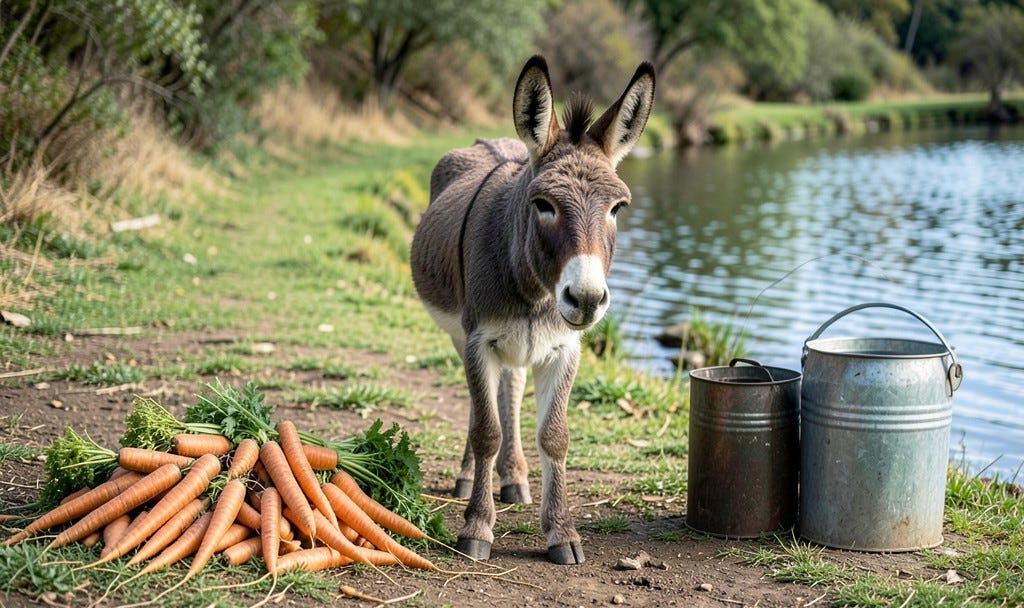
There is an old philosophical riddle about a donkey standing exactly halfway between a pile of carrots and a pail of water.
The donkey is equally hungry and equally thirsty. The carrots are to his left; the water is to his right. He cannot move toward the water because the carrots are over there, and he cannot move toward the carrots because the water is in the opposite direction.
Unable to choose between two competing needs, the donkey stands still. He stands still, and stands still - and eventually starves to death while dying of thirst.
As Seth Godin points out in The Knot: Problems Can Be Solved, no actual donkey would ever be this foolish. But humans fall into this exact trap every single day.
We don’t starve for lack of food or water; we starve because we refuse to choose.
The Illusion of Being “Reasonable”
In corporate culture and personal lives alike, we convince ourselves that trying to satisfy two mutually exclusive desires at once is a sign of prudence. We label our hesitation as careful, responsible, or thorough.
In reality, as Seth Godin explains, we have simply driven a hidden pin through the center of our own decisions. We create an internal tug-of-war by insisting on outcomes that cannot co-exist:
We claim we want radical innovation, but only within established best practices.
We demand to move fast, but insist on absolute certainty that we won’t fail.
We want to launch a new business, but refuse to risk our savings or drop past investments.
We dream of a fulfilling new career, but hold on tightly to the job we’ve spent years building.
The stickiest entanglements rarely feel like self-imposed traps; they borrow authority from external circumstances and feel like immutable facts. But trying to achieve both at the same time guarantees that we succeed at neither.
The donkey doesn’t starve because he lacks choices. He starves because he won’t make one.
The Three-Letter Breakthrough: “And” vs. “But”
If you want to spot a donkey trap in your own life or organization, listen closely to the language you use. Specifically, watch for the word “but.”
As Godin highlights in the book, the words “and” and “but” reveal whether we are making a genuine commitment or describing a self-defeating wish:
“And” reinforces and moves in one direction: “I want to run the marathon, and I’m ready to get tired.” The second clause acknowledges the cost and supports the first.
“But” undermines and cancels itself: “I want to run the marathon, but I don’t want to get tired.” The second half cancels the first. You haven’t made a commitment - you’ve stated a wish and its obstacle in a single breath.
The word “but” marks the exact spot where fear has gotten tangled up with desire. When we say we want to innovate but stay safe, or refocus a project but avoid uncomfortable conversations with leadership, we are letting fear masquerade as responsibility.
One Thing at a Time, Lots of Things Over Time
Escaping the donkey trap doesn’t require finding a magical way to have both incompatible things at once - that fantasy is precisely what keeps us stuck. Instead, untangling the knot requires naming the entanglement clearly enough to make a choice.
Godin offers a crucial distinction that unlocks forward momentum: avoiding two things at the same time is completely different from doing two things over time.
You don’t have to abandon secondary aspirations forever. You can freelance on the weekends without quitting your day job today, or embrace intense work focus now and full family presence when you return home.
Constraints are a gift because they force clarity.
To move past decision paralysis, the formula is simple:
Name the baggage: Identify the incompatible goals or unstated fears holding you in place.
Drop the baggage: Acknowledge that you cannot have two mutually exclusive outcomes in the same moment.
Ship the work: Choose one direction, embrace its inherent costs, and take action.
The next time you find yourself frozen between the carrots and the water, drop the “but,” pick a direction, and take the first step.
Your thoughts?