

That which is like poison in the beginning but like nectar in the end - that happiness is declared to be sattvic, born from the clarity of self-knowledge. [Bhagavad Gita · Chapter 18, Verse 37]
Before you reach for the snooze button, before you cancel the hard conversation, before you open another tab instead of beginning - ask yourself one question. Not “does this feel good right now?” but something sharper:
Will this taste like nectar or poison in a month?
It sounds simple. It isn’t. Because the human nervous system was not built for the long game. It was built to move toward pleasure and away from pain - immediately, instinctively, without consulting the future. And that wiring, so useful in the savannah, becomes a subtle trap in modern life.
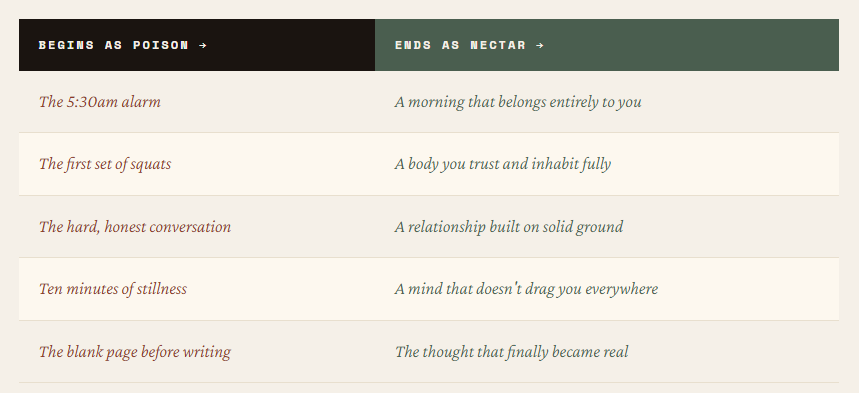
The discomfort you feel at 5:30am is not a sign that waking early is wrong. It is the price of admission to a version of yourself that doesn’t yet exist.
The Poison Phase Is Real
We should be honest about this. Waking early does feel like poison. The alarm sounds and every cell in your body votes no. The first week of a new exercise habit is fatigue, soreness, and the mocking awareness of how far you are from where you want to be.
A difficult conversation(s)- the kind where you say the true thing instead of the comfortable thing - sits in your chest for days before it brings any relief (and we all know that we suffer more in our imagination than in reality)

Similarly, meditation, especially in the beginning, is not the serene tableau of the wellness industry. It is sitting with the full volume of your own unedited mind. That is poison. Real poison. And the Gita does not pretend otherwise.
What it offers instead is a reframe so radical it takes years to fully absorb: the poison is not evidence that you are doing something wrong. The poison is evidence that you are doing something real.
Meanwhile, the Nectar Turns
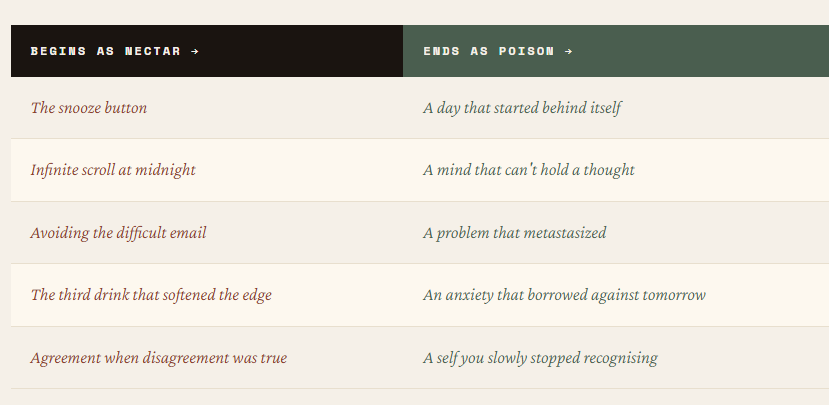
The other side of the equation gets less attention, but it may be the more important half. Easy pleasures don’t just fail to compound - they actively decay.
The extra hour of sleep that felt like mercy on Monday becomes a grey fog by Friday. The scroll that soothed a moment of boredom trains the mind to be bored more often and more acutely. The avoided conversation doesn’t disappear - it calcifies, growing larger and more distorted with every week it goes unspoken. What tasted like nectar at 11pm curdles into a kind of tiredness that sleep can’t fix
The Question as a Daily Practice
The Gita’s verse is not a commandment. It is a diagnostic. And the diagnostic becomes most powerful when you apply it in the small, granular moments that feel too minor to deserve philosophical scrutiny - because those are precisely the moments that accumulate into a life.
Will this extra episode or that chapter of the book I’ve been meaning to read taste like nectar or poison in a month? Will saying yes to this request I don’t have bandwidth for feel like relief or resentment in a week? Will this shortcut save me time or cost me the mastery I’m supposedly building?
The question doesn’t always yield a clear answer. Some pleasures are genuinely restorative and sattvic - rest, beauty, laughter, deep conversation, the unhurried meal.
The Gita is not asking us to be ascetics. It is asking us to develop what it calls viveka -the faculty of discernment. The ability to tell the difference between the rest that renews and the avoidance that merely delays.
The Practice
Before the next decision that feels comfortable in a way that makes you slightly uneasy - pause. Ask the question.
Not to punish yourself into the harder path, but to see clearly.
Will this taste like nectar or poison in a month?
Choose the temporary discomfort of growth over the temporary comfort of stagnation. Not because suffering is noble, but because clarity, accumulated day by day, is the only happiness that doesn’t expire.
Your take?